
Chapin has grown fast, and with that growth came a lot of backyard pools — many of them on lots close to Lake Murray with the same shifting, clay-heavy soil that makes leaks so common across this side of the Midlands. If your Chapin pool keeps dropping and you are refilling it more than you used to, this guide is for you.
The Leak Geeks pinpoint pool leaks in Chapin with electronic detection, pressure testing and dye testing — no guessing and no needless digging. Here is how to tell whether you have a leak and what happens when we come out.
Where Chapin pools tend to leak
Between summer heat, heavy use and ground that moves with the seasons, Chapin pools tend to leak in a handful of predictable places: skimmer throats, return and suction lines, light niches, and cracks in the shell where the soil has shifted underneath. The underground plumbing is the sneaky one — a cracked return line can lose a lot of water while showing almost nothing on the surface.
The reason it matters where the leak is: the location decides how big the repair needs to be. A single leaking fitting is a small fix. But if a company skips detection and starts digging or replastering on a hunch, you can end up paying for far more work than the actual problem required.
How to tell evaporation from a real leak
In a Chapin summer, a pool can lose a quarter inch a day to evaporation alone, so a dropping level is not automatic proof of a leak. A simple bucket test helps: float a bucket of pool water on a step, mark the water level inside the bucket and on the pool, wait a day, and compare. If the pool dropped noticeably more than the bucket, you likely have a leak. These signs point the same direction:
- Adding water far more often than last season
- Water loss of more than about a quarter inch per day
- Wet, sinking or unusually green ground near the pool
- New cracks in the deck or coping
- Air bubbles from the returns when the pump is running
- An autofill or garden hose that seems to run constantly
What a detection visit looks like
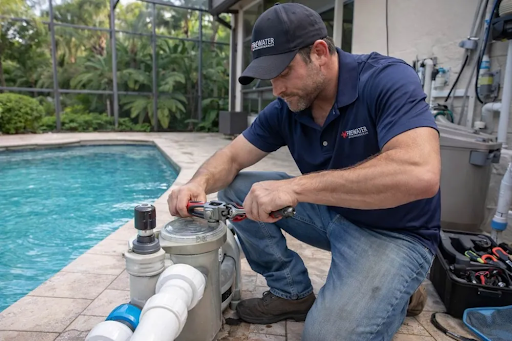
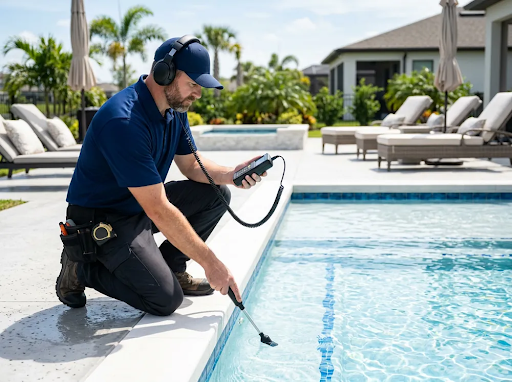
We start by confirming the loss is a real leak and not evaporation. Then we isolate the plumbing lines and pressure test them one at a time to narrow the leak to a specific line or the shell. Electronic listening equipment and dye testing mark the exact spot, usually within inches, and you get a clear picture of what is leaking and where before any repair begins.
Most residential pools take one to three hours to check, depending on size and how the plumbing was run. If we find more than one leak — common on older pools — we document every one and walk you through which matter most.
Local to Chapin and the Lake Murray area
We serve Chapin, the Lake Murray communities, Irmo, Ballentine and the wider Columbia Midlands. Being local means we understand how this soil and these summers affect pools here — and we would genuinely rather tell you the water loss is normal evaporation than sell you a repair you do not need. Call 803-570-5283 to get it checked.
Think you have a leak in Chapin?
We find it and fix it. Get a precise diagnosis and a free quote from a local, Leaktronics-certified team.
Frequently Asked Questions
How can I tell if my Chapin pool is really leaking?
Try a bucket test: float a bucket of pool water on a step, mark the level inside and on the pool, wait a day and compare. If the pool dropped noticeably more than the bucket, you likely have a leak worth locating.
How long does pool leak detection take?
Most residential pools take one to three hours, depending on size, how the plumbing was run, and how many leaks turn up.
Do you cover Chapin and the Lake Murray area?
Yes. We serve Chapin, Irmo, Ballentine, the Lake Murray communities and the wider Columbia SC Midlands. Call 803-570-5283.